
Thursday, August 22, 2013
Celebrating One Year
We have been so, so blessed by family and friends who have supported our ministry in amazing ways. It has been a tremendous privilege to see many of you this month, and again, to receive so much support and kindness. I am trying to summarize my gratitude in a post that is on its way....
But, for now, we thought we would share this video with you all, along with our very deep gratitude for your support! It is about a ten minute video, but I hope you can take the time to watch it, if you didn't get the chance to see it in Okemos or Louisville.

Sunday, August 4, 2013
In the US
In the month of August, my sister-in-law will have a baby, Joel’s grandma will turn 90, and my father will get married. And we have the blessing of being in the United States for all of these events. We also have the honor of sharing the stories of our Zambian colleagues and friends with churches, mission networks, and individuals in Michigan and in Louisville, Kentucky. It is a full month, with six speaking engagements, in addition to the very huge family events. But I cannot believe how blessed we are to be able to be here for all this, to share in the joy and the beauty of family life here in the US, and to testify to the joy and beauty of our Zambian friends.
As the month progresses, I am sure I will have a lot to share, as our niece is born, as my father is married, as Grandma VP celebrates 90 years of life. But I also would love to see those of you who are in Michigan, as we speak about our ministry in Zambia, and continue on this journey together. When we walk together, beautiful things happen, and I am excited to be walking in the United States today, to invite more and more people to join us on this journey, connecting God’s children across the globe.
Below is our US speaking schedule. Some of these events have already occurred, but if you are in the area, please join us for one of the upcoming activities. We would love to see you! If you can’t join us, and would like to connect while we are in the US, please feel free to be in touch this month, and we would be very happy to talk with you.
July 31st, Speaking at ZZM Mission Network, Louisville, KY
August 5th, Preaching at Edgewood UCC, East Lansing, 10am
August 18th, Preaching at Presbyterian Church of Okemos, 10am
August 18th, Community Presentation, Presbyterian Church of Okemos, 4pm
August 25th, Preaching at 1st Presbyterian, Lansing, 10am
Date TBD, Speaking in Ann Arbor/Manchester, MI
Thursday, July 25, 2013
Sunday, Monday, Tuesday, Wednesday...
 |
| Rev. Justin Zimba, Esther Phiri Zimba, and Grace Zimba |
Sunday, Monday, Tuesday, Wednesday...It happens every day, with a frequency that can make a person numb. Diarrhea, asthma, lung congestion...How does diarrhea turn into death? How does asthma kill someone? How can a cough be fatal?
 |
| The family supported by Nicolette's church |
In six days, I will travel back to the United States for some speaking engagements, and for my father's wedding. I will be officiating at the wedding, as I join my father and his fiance in marriage. We will eat a lot, I am sure. We will dance and we will celebrate. I will stay in places where there is constant running water, and be able to choose a hot shower whenever I want it. I will even be able to drink water out of the tap! I will not have to deal with constant power outages, and I won't have to check for snakes whenever I want to take in the laundry. And while we are there, we will get some significant medical work done for both of our children. Our family can just get on a plane and leave behind the constant tragedies we witness here.
It is true, as I have written many times, that when tragedies occur here in Zambia, love pours forth, and people are surrounded with comfort, compassion, and support. I believe it is remarkable and inspiring that the people here are not numb to the pain of death, and they do not just accept that which is unacceptable. Instead, they mourn, they soothe, they show up for funerals and visitations and hospital stays. They bring food, they donate money, they pray, they sing, they sit in silence and solidarity.
But today, that is not enough. I am sick and sad and angry. My children are outside playing with a dozen other kids. These kids laugh and climb and goof around just like any other children. But if my kids get sick, we can get excellent medical care. If their friends get sick, we just have to hope that they survive. Hope and pray.
And so I come back to prayer, back to faith, back to the mystery of a God who loves us and sustains us through tragedy. I can get angry. I can become furious. I can weep with worry and guilt. But my Zambian friends choose to pray. They choose to praise. They choose to trust. They choose to have faith. They believe that there is something bigger than death, a God of love who is with us in life, and beyond. My Zambian friends are certain that there is something more, something bigger, than life itself, and they have found hope in their Christian faith. They believe that the promise of heaven, the assurance of grace, and presence of God, will never fail them. And so they endure, they move forward, they live with pain and are sustained by faith.
I have so much to learn. Today is a day when my faith falters, when my assurance is weak, when my struggles become almost too much. But God loves me anyways, and God is stronger than my frustration, my anger, my sadness. And if God is strong enough, big enough, gracious enough, to see my Zambian friends through their immense pain, then I think that God is strong enough, big enough, gracious enough, to get me through the sadness, too.
Please pray for my friends today, and especially for little Victor Phiri. And may we all pray for a faith that is strong and powerful, as we seek to love God, love God's children, and be God's hands in the world.
Tuesday, July 16, 2013
A guest post from Nicolette
.jpeg)

The advice I received as I prepared to leave for Zambia was to lay out everything I wanted to bring, then pare it down to only what I needed to bring, then cut that by half. It's not that I have never had to travel light - as a child my dad would take me camping. He would carry the food, the tent, the cooking supplies, the sleeping bags, and his clothing. I would carry my clothes, my teddy bear, and the water. Usually I gave him the water part way up the mountain.
However, as I started making the list of what to pack for Lusaka a full month before leaving, I emailed Kari over and over, asking what to bring, what not to bring, what the weather was like, what I would be doing. I knew that I would be there for about a month, but was reassured that I would have access to things like a washing machine and (usually) running water. I knew I would have electricity for most of the day, and hot water on most days, and that there were stores though their selections were limited and often expensive.
I intended to fill half a suitcase with my things, and half a suitcase with things to leave in Zambia for Kari, her family, and her church. In response, my church began collecting crayons, and soon supplied me with 27 pounds of them. Friends of mission projects in Zambia from Kalamazoo sent additional supplies, so in the end I had one large suitcase weighing 43 pounds filled solely with art supplies, and a much smaller one with my things. Kari was thrilled that I had brought so much from America to support her work here.
.jpg) However, it soon became clear that what seemed like an abundance was also completely inadequate. What seemed like mountains of crayons actually only worked out to 24 crayons per church, or 4 crayons per prayer house (like a church within a church). I thought to myself 'we didn't do enough...I should have brought more.' Knowing I could have brought an additional 7 pounds of supplies and still have been within the airplane weight limit filled me with regret.
However, it soon became clear that what seemed like an abundance was also completely inadequate. What seemed like mountains of crayons actually only worked out to 24 crayons per church, or 4 crayons per prayer house (like a church within a church). I thought to myself 'we didn't do enough...I should have brought more.' Knowing I could have brought an additional 7 pounds of supplies and still have been within the airplane weight limit filled me with regret.
Every day I caught myself saying "I wish I had brought _____ with me" for everything from more crayons and art supplies to chocolate chips to ziplock baggies to stockings to UNO cards.
However, the truth is that I could have filled both suitcases, and my purse, and my carry-on with supplies; I could have paid to bring more bins on the plane filled with crayons and chocolate chips and toiletries, and it would not have felt like enough.
Having never been to a developing nation before, coming from a place of lavish wasteful abundance and traveling to a nation where so many people have so little, my first instinct was to solve problems by bringing everything from America and giving it to the people here. Starving? We have so much food in America that we throw 30% of it away (http://www.usda.gov/wps/
However, just dumping supplies into a culture, without having understanding of the socio-political-economic impact of what we bring can do more harm than good. Campaigns like 1 Million T-Shirts for Africa were started with the best of intentions, but flooding fragile economies with free t-shirts would have devastated the local textile producers. Articles like this one from Time (http://www.time.com/time/
Quick fixes to symptoms of poverty - like free clothing, shoes, soap - are tempting. Didn't Jesus tell us to clothe the naked, visit the imprisoned, give water to the thirsty, feed the hungry? Certainly, charity has its place, but should be done carefully, and in conjunction with partners who have cultural understandings of the place where aid is being given to prevent horrific unintended consequences.
So, here I am, feeling like what I brought with me was completely inadequate, yet also realizing that Zambia does not need me to come and fix its problems. Kari's last blog put it beautifully - the struggle between wanting to simply help and fix (without concern for longterm consequences), and doing the harder work of sustainable development, is the struggle to be patient. In churches, we speak of "asset mapping," using the strengths and gifts of the worshipping community in new ways so that it can thrive long into the future. It takes work, patience, persistence, and creativity, but sustainable development empowers the people living in Zambia to find culturally appropriate solutions to their own challenges, using their gifts and resources in new ways, far more effectively than I could do as an outsider.
Of course, it is true that there will be times when global partners are needed to support certain projects. Little things, like carting a suitcase full of crayons halfway around the world, bringing a soccer ball to a child my church sponsors, or an extra package of 'birdies' so the neighborhood children can play badminton, can make a real difference to children who may not otherwise have access to such luxuries. Larger projects, like digging wells and pit latrines, benefit from partnerships, but the impetus for such must always come from within the community.
It's hard to remember that though our intentions are good, the best solutions will come from within local communities. In America, we could learn a lesson from the selfless giving of people who are willing to come together, neighbor with neighbor, to work together towards common community goals.
In the end, I think I made really good choices about what I packed and what I left behind. I am grateful that in deciding what to bring, my greatest problem was one of abundance and worry over bringing too much. The cleansing cloths (that look like baby wipes) caused quite a stir through airport security, but have been helpful on mornings without water. The three pairs of shoes, that still seem excessive, have been well worn. The neck pillow for the plane was perfect, and I'm already on the second wearing for most of my clothes.
Sure, there are things that I wish I had here, but I also know that too many things can become more of a burden than an asset. We start to focus on what we have, and what we want, and forget that as God's people we are called to share and to be generous with our blessings. The opportunity to be here, to see the work that Kari and Joel are doing in conjunction with CCAP, has reminded me of the gift of living simply, of loving God, of sharing with neighbor. I pray that I will carry this gift with me when I return to America, and have the opportunity to share it with others.
Wednesday, July 10, 2013
A Long Drive Home
 |
| Oversight & evaluation of Community Health Evangelism |
 |
| Rev. Dr. Victor Chilenje discussing CHE with community trainers |
The women and men have travelled from their villages, where homes are made of mud and roofs are woven branches. After days of training, they have engaged their communities in health education, seed projects, a child nutrition initiative. There are changes in the villages, to be sure. Pit latrines have being dug, and as human waste disappears from the bush, there are fewer flies, fewer diseases. Dish racks have been built, a simple way to keep dirt off of plates and pots. Children are eating more nutritious food, as families learn how to balance their diets, using vegetables and fruits that are easily grown.
 |
| With the CHE workers in Petauke |
 |
| With the CHE workers in Nyimba |
These health workers also engage in evangelism, proclaiming God’s love for all people. They speak constantly about love, loving their neighbors, loving God, seeing God’s love for their bodies, for their children, for their spirits, for their lives. One woman says, “It was like we were asleep, but now we are awake.” They are energized and excited. “All of this is about love,” says one man, drawing a triangle in the dirt. “Love between people,” he says, as he traces a line between two people on the ground. “Love for God,” he says, as he draws a line from the person, going up. “Love of God for us,” he says, as he draws a line from God going down. In the middle of the triangle, he traces the word “love” in the dirt and underlines it. “This whole thing is about love,” he concludes.
But the questions linger. “We have dug the latrines,” one man explains. “But there is no cement to build the walls.” Another woman speaks out, “There are so many orphans. They need food. We need more resources to feed them.” All of the participants face me with expectation. I am squirming. I love the stories of change, the stories of love, the stories of healthier children and communities. But this is also the reality: we need cement, we need food, we need soap. What do we do?
As I prepared to leave the villages after a couple of days, I anticipated a six hour drive back to the capital. I would be driving on my own, which is challenging for me, but the challenge became even more intense when I discovered that there was a fuel shortage in the area. There was no fuel at any of the gas stations, and the closest place to get fuel was 5 hours away. I couldn’t make it five hours! I needed fuel.
 |
| Community health evangelists discussing projects in their villages |
The community came together and found me enough fuel, hopefully to make it to the gas station five hours away. I took a deep breath and began to drive. It was stressful enough to travel those winding mountain roads through the Zambian bush, but the worry of running out of fuel did not leave my mind.
On the way out of the village, I stopped along the side of the road, to buy something to drink from a vendor there. As soon as I got out of my car, a young man approached me. He had participated in yesterday’s monitoring. We greeted one another, and after a few moments of conversation, he asked if I was returning to Lusaka. When I told him that I was on my way there, he looked up at me with hopeful expectation. “My mom needs to get to Lusaka. She needs to bring a baby back to her parents, but there are no buses today. Can she go with you?” I breathed deeply, thinking about the precarious gas situation, the winding roads through the bush, and a woman with a baby added to my car. At first I hesitated, but I simply could not say no. Catherine settled into the back seat, holding baby Mary, and I said a prayer as we started out, that we might get baby Mary safely back to her parents.
The drive was full of challenges, and there were times when I was sure our gas would not get us there. At one point, I was ready to give up, and Catherine quietly said, “I am praying. With God, all things are possible.” I kept on driving, holding tight to the wheel and trying not to let fear overwhelm me. Each time that I felt panic, I also felt something else. I felt Catherine’s prayers, traveling from the backseat, to surround our car with prayer. We kept on going. It took six hours, but we finally made it to a gas station with fuel. My gage was on empty, and as we pulled up to the pump, I heard Catherine let out an audible sigh. But then she started laughing, and I started laughing, and we both said a prayer of thanks. We were going to make it to Lusaka.
I kept thinking about the soap during the drive home. “We teach them to wash their hands, but how can they, when they do not have soap?” I wanted to get home and to bring baby Mary safely back to her parents. But how can I, when I do not have fuel? Somehow, we got there, and somehow, these community health evangelists are getting there, too. At the end of the meeting, they decided to pool some of their resources to buy soap, and began to talk about income generating projects, to create a source of sustainable revenue to fund the community health projects. The answers were not all there, but the faith was in abundance. We will get there. Yes, we will get there.
Sustainable development is harder than relief. We don’t just hand out soap today, because there needs to be soap tomorrow, too. Sustainable development must be creative, risky, and challenging. Sometimes, it involves disappointment. Sometimes, it involves fear. It is slower, it is less flashy, it can make people squirm. Certainly, it makes me squirm sometimes, when I just want to do relief, and give up on the very challenging work of sustainable development.
 |
| Catherine and baby Mary |
But as I sweated my way through the bush of eastern Zambia, and somehow made it home, I remembered that the long, hard work of sustainable development will help us all to arrive. Because God is with us, to help us reach our destination. And God sends people, to pray us forward, to move us forward. Without Catherine, I don’t know that I would have made it home that night. Without her prayers, her presence, her calm encouragement, I know that fear would have overwhelmed me. But I believe that God sent Catherine to me, to ride with me on the long, scary, winding road.
God is working in the villages, as well. We will get there. Yes, we will get there. Because Catherine is sitting in the back seat, praying us home. And so are many of you. So, thank you for praying us home. Please stay on the journey with us.
Thursday, July 4, 2013
Johnny's Birthday Party
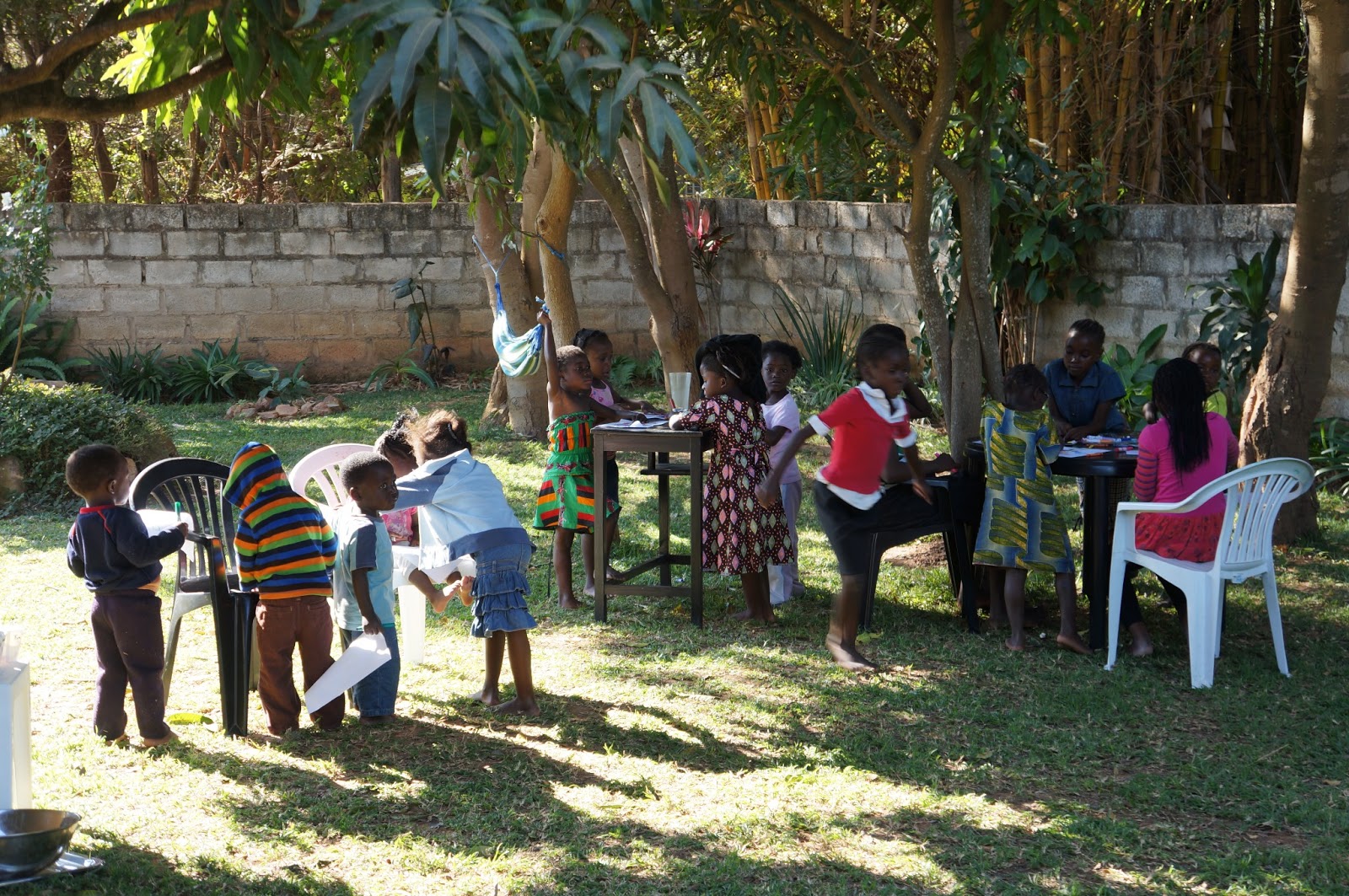
 Johnny turned six on June 24th, so this past Saturday, we threw a birthday party. It involved 31 children, 2 adults, a lot of sugar, a very large bounce house, and kids who are not all that accustomed to enormous inflatable playhouses. So, yes. It was fun and hilarious. As an added bonus, there was no blood. Here are the photos:




Thursday, June 27, 2013
Our Induction
 On Sunday, CCAP Zambia held an induction service for Joel and me. Worship began at 9am and it ended around 2pm, with a meal afterwards. Now, one might think that sitting through a five hour worship service would be an exhausting ordeal. But this was simply not the case for us; it was energizing, exciting, full of life, but most of all, a precious gift.
I am not sure how many choirs sang: the Mandevu women’s choir, the Matero men’s choir, the Matero women’s choir, the children’s choir, the Bethel choir, the Chawama choir, the Section of John choir, and a few others. The music went on an on, complete with dancing and laughter, and a few high pitched cheers of joy.

 There were speeches; the president of the Council of Churches for Zambia was the honored guest, and he offered an ecumenical address, encouraging Joel and me in our ministry. The sermon was delivered by a colleague at the Chawama CCAP congregation. Our Regional Liaison, from Presbyterian Church USA, gave a beautiful speech about the power of partnership.
  At the end of the service, gifts were presented. The gift presentations alone took over an hour. Group after group processed forward, dancing and singing, their arms laden with wrapped presents. We received over 60 gifts, and they were held high, as people streamed down the aisle of the church, dancing their way towards us. Present after present piled up, person after person hugged us, smile after smile offered us beaming congratulations. We shook hundreds of hands and there were a few times that I simply could not contain the tears. How is it possible to be so welcomed? How is it possible to be so loved? How can I even begin to thank our Zambian partners for their generosity, their kindness, their infectious, inspiring joy?
 One of my colleagues traveled by bus from Northern Zambia to attend the induction, arriving in Lusaka at one in the morning. I was overjoyed to see her, and humbled that she had traveled through the night just to attend our induction. Others rode buses for an entire day just to be present. As an incredible blessing, my mother and Joel’s parents were able to travel from the United States to be present at this unique and beautiful ceremony. American friends in Lusaka made their way to the event, as well. It was remarkable to look out and see our Zambian friends, American friends, neighbors, colleagues, and even parents, gathered in this church, in a compound in Lusaka, to sing and dance and praise and celebrate together. Wow.
 When we returned home, we opened the gifts. There is no way to name all of the things we received: beautiful Zambian clothing, exquisite cloth, copper clocks in the shape of Zambia, pots and pans, glasses and mugs, wall hangings, a coffee maker, a toaster, a dvd player, a sound system, a Chichewa Bible, and on and on and on. We even received a satellite dish, a large flat screen television, and a cable subscription. Now, Joel and I have never, ever had cable, and in fact, we went for years without a television. But, the people in the Synod, our CCAP friends, wanted to be give us above and beyond what we would ever, ever think to expect.
 My house is now decorated with signs of this love. When we drink water from our new glasses, when we sip from our new mugs, when we see the time on that lovely copper clock, we witness the love and community that surrounds us here. These gifts stand as a testimony to the powerful, fierce, courageous love that our Zambian brothers and sisters display for us, for their church, for their community, and most of all, for God.
 I hope to one day be as generous, as courageous, as faithful as my friends here. In the meantime, I will choose to simply say, “Thank you.”
Subscribe to:
Posts (Atom)