Thursday, November 28, 2013

Our Thanksgiving

My plan was to ignore Thanksgiving this year; I figured that was the best I could hope for. Maybe, if I ignore it, I won’t feel this aching longing to be with my mother, my sisters, my nieces and nephews...Maybe, if I ignore it, I won’t miss the pie and the stuffing and the fudge that Joel’s grandma always makes....Maybe, if I ignore it, I won’t be frustrated that I have chosen to live half a world away from the people I love the very most.

Last Thanksgiving, we had been in Zambia for less than two months, and I remember spending a lot of that day in tears. In the kitchen, trying to cook, trying to make Thanksgiving work, while tears flowed and frustrations grew. And just as I was attempting to create some semblance of a Thanksgiving meal, the power went out. No electricity, no water, and a half cooked meal. I think that was the point that I sunk to the floor and asked Joel to just leave me alone to sob in the kitchen.

So, this year, my goal was to ignore it. I could be thankful, that was for sure. And I try to be thankful every day. There is so, so much that I am thankful for. But on this day, I figured, I could just give myself a break, and get through it. Without tears. That seemed a good goal.

And then, some American friends invited us to their house for Thanksgiving. I took a little while to respond, but I knew that I wouldn’t be able to ignore Thanksgiving anyway, so we accepted the invitation. They didn’t ask us to bring anything; we chose a few things to take along, but they cooked and created and brought us to their table. And not only was it a Thanksgiving feast, it was a vegetarian Thanksgiving feast, and our family is vegetarian. It was delicious.

Something happened today, as we prepared food with friends in their kitchen, as our children played together, as we all joined hands and shared what we were grateful for, as we ate and laughed and shared our stories...I realized that I was having Thanksgiving. Not a tear-filled day of missing my family, not a stubborn day of ignoring my pain, but a real feeling of gratitude, for these people who were strangers to us a little more than a year ago. But even more than that, a feeling of gratitude that no matter where we are, we are never far from love.

We were far from home today, but we were not far from love. We were invited into a home, to share in that love, to share in the gratitude of the day. I was ministered to, and cared for, and fed. And that is exactly what I needed. And I am so grateful.

Lately, I have heard way too many horror stories. Really, really bad stuff about pain and suffering and violence. From Joel’s travels in South Sudan, to my colleagues’ terrifying accident, to a friend struggling to keep her son alive, I have spent days sick with sorrow. But I do believe that we are never far from love; that no matter what we are going through, whether it is simply being homesick, or having one’s heart ripped open, God’s love is present and powerful and real. In fact, this is the one and only thing that I really can depend on.

And so, today, my friends reminded me of this love, through their kindness, their invitation, their open home, and they filled me with gratitude. There is love. It is real. It is God. And I do believe that this is the foundation of everything that makes me feel grateful. 

Thursday, November 21, 2013

Last weekend in photos

Frankie's birthday party: 20-something children, 2 adults

A very sweaty birthday boy

Our friend Precious 

Lots of smiles, a few tears, no blood

Art table

Bounce house

More art

Ball games

Singing Happy Birthday and cupcakes

Sunday morning worship
Frankie singing with the choir

Making a funny face while preaching in Chichewa


Johnny doing a seriously awesome dance, a little preaching


Home for Scrabble by candle and solar light (Johnny did "quiz" and was very proud!)

Friday, November 15, 2013

Yoga in a refugee camp


My memories of yoga are not all that fond. It was pregnancy yoga, eight years ago, and I was the only person in the class required to use a chair. I simply could not do it, and the instructor was worried I would break myself. So, I got the "special" station, where I could use a chair for balance and support. It was not a pretty sight, and after about a month, I gave up. I decided to dance instead. 

This past week, Joel came back from South Sudan. And during his time in a land that has been devastated by interethnic violence and civil war, he worshiped in a refugee camp. They sang and danced and played drums. They praised God with joy and clapping. Many of these people had seen their family members murdered, their houses burned to the ground, watched their loved ones die. But they believe in a God who is more powerful than the violence they have endured. They believe that God’s love will win, that life will triumph, that there is reason for hope.


And at that refugee camp, they also have a yoga class. It is amazing to me to think about people who have lost everything, spending time stretching their bodies and paying attention to their breath. The woman who teaches the yoga class maintains that the refugees are incredibly strong; they can hold positions that most other women cannot. They are strong. They are breathing. They are holding onto hope.

Joel shared so many devastating realities; one of the stories that he heard over and over again has to do with dowries. A man has to provide hundreds of cattle for a dowery, which he does not have. And so he steals cattle from another tribe, killing the owners and often their families in the process. After awhile, the other tribe takes revenge, stealing the cattle back, while murdering the original thief and his family. This happens again and again, as cattle are stolen and re-stolen, as people are slaughtered in order to provide an unreasonable dowry. When I think about the joy, the love, the new life that is supposed to define a wedding, this horrifying practice of stealing, killing, and revenge makes me so deeply sad.

Joel also mentioned riding through South Sudan with his driver, who explained that one should never argue with a police officer. “They will just shoot you,” said the man. He went on to reassure Joel that he had his own guns hidden in the trunk. At the schools Joel visited, he saw teachers walking around with large sticks. The sticks were used to keep the children in line; beatings are all too common. Domestic violence, as well, is rampant. In a country that has only known war for twenty-two years, violence seems to lie just below the surface of most interactions, and is often considered the only way to solve a problem. 

What do we do with all this? We find our way to God. Our way to pray and worship and build. Our way to breathe. We join with other people of faith and we claim our power. We support ministries of reconciliation in places of violence and pain. The women in that refugee camp refuse to give up; so must we.

The stories from the typhoon in the Philippines, the Ethiopian adoptee abused and murdered in the US, the cuts to programs that feed the hungry. These things make me feel hopeless and sad. But then I picture the refugee woman in South Sudan, doing yoga and then getting up to dance her faith. And I know there is a God. I know there is something more powerful than all this pain, all this death, all this horror.

I believe that God works through the church, the body of Christ, to bring peace, to bring hope, to bring reconciliation. As Joel traveled, he saw people doing incredible work of transformation. RECONCILE, one of our partners in the Presbyterian Church, USA, brings together people from different ethnic groups, to work on peace-building, justice, and forgiveness. Theological colleges, also PCUSA partners, train new leaders to live out the love of the gospel. South Sudanese Christians and mission co-workers come together and declare there is hope, there is breath, there is a future. For they believe in a God of liberation, a God of reconciliation, a God of transformation.

There is yoga in a refugee camp. There is dancing in a refugee camp. There is worship in a refugee camp. There is breath. There is joy. There is God. 

Monday, November 4, 2013

Goodbye

At the goodbye picnic
A very good friend is moving today. She just called me from the bus station. It will be all day on a dilapidated bus, packed full of people, hours at the border crossing, and finally, she will arrive in the middle of the night, in Zimbabwe. She and her husband and their two boys will soon start a new life in Zimbabwe, in a town she has never been to. They will struggle to survive on the funds that a poor church can raise; they will simply live in faith that God can provide enough.

She wants to send her boys to a good school; she worries about the fees and if she will be able to afford a decent education for them. She is smart, educated, incredibly generous, faithful, loving. I know that she will figure it out; I know that she will succeed. But it will be hard, so hard. So much harder than it is for me.

I have written about her before; she is the nurse, who cared for the epileptic man with severe burns. If you didn’t read that post, you can find it here: http://lovinglusaka.blogspot.com/2013/05/epilepsy-fire-and-faithfulness.html

My friend is a model of love and faithfulness and goodness, and she held me up so many times. She loved me through every pain. She inspired me and walked with me and made me feel like I was not alone. She has been a sister for me here, and thinking about her getting on that bus in one hour hurts my heart.

She is also pregnant. She found out on Wednesday that it will be a little girl. She is due in February, and since I will not be there when the baby is born, I gave her baby gifts over the weekend. A smile lit up her face and she said, “It is a gift of hope. Hope that the baby will come.” I thought about baby showers in America; we don’t call them gifts of hope. We just assume that the baby will come, that all will be well. But for my friend, that is not her assumption. That is her hope.

I took her out on Friday to a restaurant, for a goodbye meal. I asked how she was feeling about the pregnancy, about delivery in the town that she does not know. She began to tell me stories; as a nurse, she had some horrific ones. “One girl, she was only 16. She was pregnant, and trying to deliver at home. It was expensive to deliver in the hospital, so she was in her house. Labor stopped, and she kept pushing, but the baby was stuck. The midwife told her that it was her fault, that she had done something wrong during the pregnancy, and that the girl needed to admit it, or the baby would not come.” My friend’s face was creased with sorrow. “They would not take her to the hospital until she admitted her crime. There was nothing to admit, and by the time she had pleaded to go, it was too late for the baby. The child died, and we had to remove that young girl’s uterus. The girl survived, but can you imagine?” 

My friend went on to explain that some people believe that any labor complications are the fault of the mother. Either she had an affair while she was pregnant, or she infuriated another woman, who then cursed her. The woman must admit her crime before the baby can be born. My friend said that she had seen it many times; women die because of it. 

I kept looking down at the little swell in her belly, the little girl that was forming there. Oh, how I wanted to protect that life, to cover my friend with all of my privilege, to allow her the security and safety I felt during my pregnancy. She smiled again as she took the two wrapped gifts. “I will wait to open them until the baby is born,” she said. “I will have the discipline to do that.” I looked at the gifts of hope, at my friend, and felt my heart break again.

Together on campus
I thanked her for letting me be me, for being patient and helpful with all of my learnings and fumblings and mistakes and questions. I thanked her for being a friend when I really needed one. 

I keep thinking of a night about a month ago, when Frankie’s fever spiked high, 103 degrees, and I was home alone, and scared. I called her, and although she was in middle of making dinner, she came immediately to our house. She brought a malaria test, a thermometer, medicine...Her husband came, too, lifting Frankie up in prayer. They offered to take us straight to the clinic, leaving behind their food, their needs, to make sure that my sweet boy would be okay. That is who she is, who they are. And I hate it that she is getting on a bus in an hour. That I can’t just call her and know she will be there.

But I am so grateful that I got to know her, that I had the privilege of calling her friend. I am so grateful for the pain of missing her, because that means I had the joy of knowing her. And I am grateful for the excuse to go to Zimbabwe, to visit my friend, and to meet her little daughter, after that baby is born.

Holding a friend's baby
We will both hold onto hope, the gift of hope. That is what she gives to me, that is what God gives to us. Hope in a God who is big enough to see us through. Hope in a God who creates beautiful people. Hope in a God who works through friendships, allowing us to experience the power and the beauty and the wonder of love. 

Tuesday, October 29, 2013

Auntie, I want up!

This is Isaac. Isaac is adorable. Just plain straight up crazy cute. And he spends a lot of time at our house.

Yesterday, I was working from home, and there were nine kids in the house, a pretty normal afternoon. The older boys were painting at the dining room table, some other kids were coloring, and others were playing foosball. (Yes, we have a foosball table in our home. It is a loan from neighbors who are now in the US....)

Sitting at my desk, trying to write curriculum, I could hear the noise of the ball flying across the wooden stadium, children arguing over crayons, and the older kids, occasionally showing one another their creations. From time to time, one of the young artists would bring in a masterpiece for me to admire.

Just as I was working on a story application for Jesus' healing of the 10 lepers, Isaac walks in. I am ready for him to ask for an apple, to ask for more crayons, to ask me to make the other boys share the foosball table. "What do you want, Isaac?" I asked him, as he is one who is usually full of demands. Really, he is so crazy adorable, he can get away with this. He looked up at me with his enormous eyes and replied, "Auntie, I want up." I needed clarification on this. Not a banana? Not a toy? Not a glass of water? "What do you want, Isaac?"

"Up, Auntie. I want up." Well, okay then. I lifted him onto my lap, and he became an octopus, arms tight around my back, legs around my waist. "You just want up, Isaac? I am just going to be working here." He nodded and said, "Yes. I just want up."

And so, I turned to the computer and commenced with the rather challenging task of writing curriculum while embracing a three year old child, who was clinging to me like a life raft. His brother came in, trying to pry him away with a few toys, but Isaac would not budge. He just wanted up. He just wanted to be held. He just wanted to rest in someone else's arms for awhile.

I didn't get a lot of writing done, but in holding little Isaac, I realized how much I am like him. None of the toys or crayons or foosball tables or paints or apples or bananas in the world can really satisfy me. I can keep gathering things together, and try to build up a life that makes me feel safe. I can have a healthy savings account, a good safety net, a reliable car. But mostly, I just want up. I just want to be held. I just want to rest in someone else's arms for awhile.

And the arms that have always held me are those amazing arms of love that never fail. The one who will lift me up is the One who is always there, no matter what, no matter how I fail. When I just need to be held, I know that God is there to hold me. And when I say, "Auntie, I want up!" God is waiting with open arms.

Love is what we need. Open arms, open hearts, open lives. Open to the power and strength and gentleness of God. Open to loving one another.

Isaac was not satisfied with any of the things in the house. What he needed was love, arms wrapped around him, the promise that he is not alone. I know that I have never been truly satisfied by any of the things in the world, either. What I need is love, arms wrapped around me, the promise that I am never alone. And I am so grateful to follow a God who offers this time and time again. No matter what, no matter where, no matter who, when we say, "Auntie, I want up!" God is ready with open arms.

Thursday, October 17, 2013

Overflowing


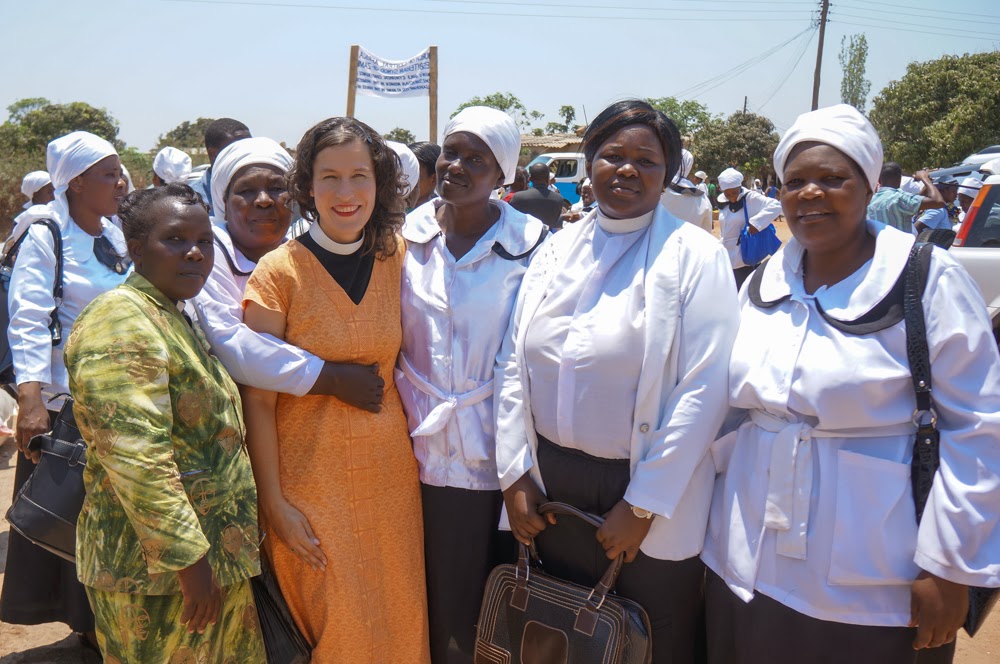
Over 800 women. Coming from Zimbabwe, Malawi, and all over Zambia. Sitting on the hard, concrete floor all day long. Singing and dancing all day long. Praising and preaching all day long. For five days. The building was overflowing. The Spirit was overflowing.

The theme of the conference was Women in Ministry and Leadership. The guest of honor, Rev. Suzzane Matale, spoke of women’s equality, education, and empowerment. Her passion, her eloquence, her energy was incredible. She offered a message of liberation, which was linked intrinsically to Biblical literacy. The freedom, the hope, the justice, the equality that she preached came straight from her reading of the scriptures. God wants you to know that you are beautiful, she said. You can do anything. Anything at all. The women were on their feet, cheering, laughing, clapping. Overflowing.

At the end of the talk, she had us all look into the eyes of another person and say, “I love you. I need you. I care.” Looking into the eyes of a beloved colleague, I knew how very true these words were. “I love you. I need you. I care.” The love. Overflowing.

I was also blessed to be one of the speakers, with my talk translated into three different languages. It was overwhelming to look out and see all these women, all this joy, all this love, all this power. My gratitude. Overflowing.


My talk focused on how we can overflow with the presence of God, when we open ourselves to the Holy Spirit, take care of our own needs, and live in love with one another. I spoke of strong Biblical women and Jesus’ message of liberation, freedom, and justice. I filled a pitcher full of water, and just kept on pouring until it overflowed. The living water, I said. It is for us and it can fill us, until it just spills out all over the place...Living water. Overflowing.

All week long, God was spilling out all over that place. Overflowing. My friends, my colleagues, so many women, filled with the Holy Spirit. Overflowing. What a blessing to sit among these faithful women of God; to be drenched. Let it flow, my friends. Let it flow.


Monday, October 7, 2013

I Will Dance With You


In the circle of pastors, I was the only white person in the room. Mostly men, a few women, leaders of the denomination. And I have to admit it, there were a few times that I wanted to leave, a few times that some words about gender made me squirm, a few times that I wasn’t sure how to respond, a few times that I was just so sure that I didn’t belong, so sure that I had gotten in too deep.

It was a real conversation, about women and power, about family and leadership, about children and parenthood. And one of my beloved colleagues, a friend who I deeply admire, spoke up, “I think it is that Western culture has come here too quickly. We don’t know what to do.” I stopped squirming and I started to listen. Real concerns about gender, real concerns about power, real concerns about how the church can embrace gender equality and still maintain its Zambian identity, still uphold the value of the family as they know it. I stopped squirming and started listening. And this is what I heard...

A man I do not know all that well, a Zambian colleague in his fifties, spoke up, “I have children who are teenagers. They are the children of a pastor, and I wanted them to act like it. I wanted them to show that they are my children, the pastor’s children. I wanted them to make me proud.” He paused and shook his head. “They knew that I did not like secular music, and when I was in the home, they would only play Christian songs. But one day,” he said, “one day, I came home early. The children scrambled to turn off the music, but it was too late. I walked in and found all four of my children laughing and dancing to secular music. They apologized right away and looked at me with fear. They were so afraid they would get into trouble.”
 

He smiled ruefully. “I asked, and I found out that they were doing this often, when I was not home. They were dancing without me. And so, I told them to turn the music back on. They didn’t do it at first, but I requested it again. ‘Turn the music back on.’ And then I said, ‘I will dance with you.’ And we all danced together, and we all laughed together, and it was fun. It was good. It was beautiful.” He paused again. “They need to be who they are. I cannot tell them who to be. But I can dance with them, and trust that God will be with them in their future. God is in charge of their future, God is in charge of who they will be. I am not in charge of that, so I can dance with them and they can choose the music.”

I loved that image, this 50 year old, staid Zambian pastor, dancing with teenagers to secular music, in his parsonage home. When I told him later how much I loved his story, he said to me, “It took me time to learn. I wish it had not taken me so long to learn that I needed to let them be themselves. But now I know. They need to be who they are.”

If only we could do that in ministry, in our churches, in our families, in our lives. If we could let people be who they are, and love them where they are. If we could just say, “I will dance with you,” instead of criticizing the dance music, or asking that the volume be adjusted. We can do our own dance moves, but can’t we dance together? Can’t we be who we are and give other people the same courtesy?

It made me think about about the challenging discussions on gender. I will be who I am, a woman in ministry, with a husband who is usually home with the children. And they will accept me, and love me, and try to understand why it is that Joel almost always cooks dinner. They will dance with me; will I dance with them?

These uncomfortable conversations are one way that we dance together. When we tell the truth about who we are, what we think, where our challenges lie, and then we listen to the other people talk about who they are, what they think, where their challenges lie. This is how we dance together. This is how we let people be who they are. And when we do this, we all move forward, when we do this, we all get a bigger, better, more wonderful glimpse of God.

I am grateful for the challenges of working here, for the ways that it draws me out of my comfort zone, for the conversations that make me uncomfortable. Because these new dance moves come in handy. These new partners introduce new rhythms. And I love to dance, oh how I love to dance...

So, thank you, Rev. Kalinga, for dancing with your children, for letting them be who they are, and for letting me be me. May we all learn from you. May we all join the difficult, interesting, life-giving, challenging, beautiful, squirmy, messy dance. May we choose some different dance partners, choose some different songs, and see where the music takes us.